
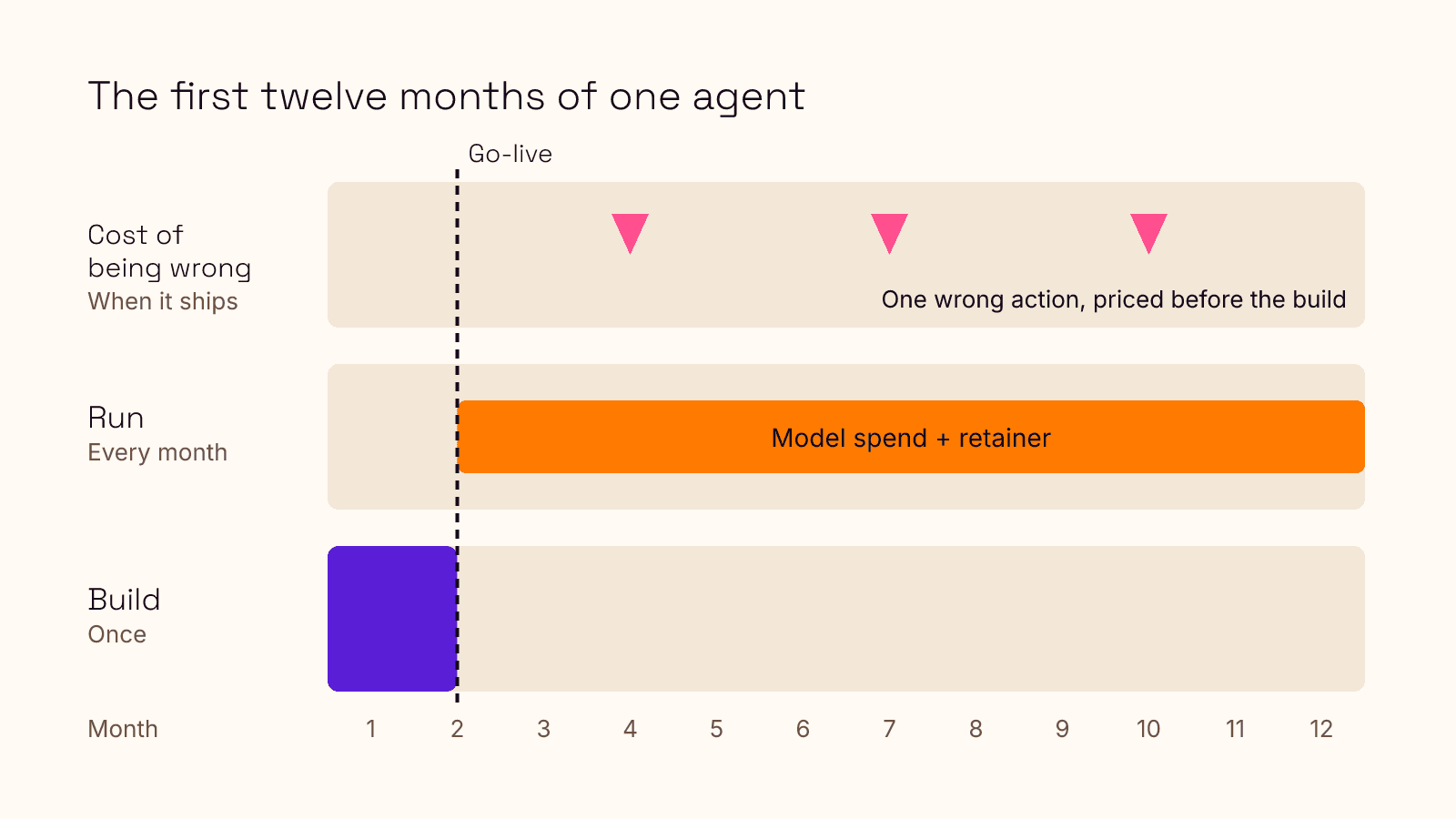
An AI agent carries three cost lines, and most quotes show you one. The build is the number on the proposal. Running it bills you every month. The third line is what the agent costs you when it is wrong, and nobody invoices you for that one until it happens.
This note prices all three. Where a published figure exists, you get it with its source. Where one does not, you get the arithmetic to do yourself.
If you have not yet decided the loop deserves an agent at all, settle that first with the five questions that decide it.
The three cost lines
Add all three over twelve months before you compare two proposals. A cheap build with an unpriced run can still be the expensive option.
| Cost line | When you pay it | What sets its size |
|---|---|---|
| Build | Once, before go-live | Systems the agent touches, actions it may take, how hard the test is to prove |
| Run | Every month | Runs per month, tokens per run, and the retainer for keeping it working |
| Being wrong | Whenever a mistake reaches someone | Who sees the mistake, and how fast you find it |
The first two lines appear on paper. The third appears in your inbox, usually from a client.
How much does it cost to build an AI agent?
Cleveroad, a development firm that sells these builds, publishes build estimates from $20,000 to more than $200,000 across its tiers. Where your agent lands in that spread depends on the systems it touches, the actions it may take, and how hard its test is to prove. Which model you pick is rarely the deciding line.
Every system is an integration somebody has to build and test against your real data. Every action is a permission somebody has to scope; each one also needs a planned failure path. The test decides when the build is finished, so write that test before you build. Without one the build never finishes, and the invoice keeps growing.
SideKind prices the build as a fixed price at signed scope. The scope comes out of a design phase of 5 to 10 business days.
You get one paragraph on the agent's job and a list of every system it touches. You also get every action it may take, and the test sentence, signed.
A SideKind build goes from signed scope to live in 3 to 4 weeks. Your own decisions during those weeks move the timeline, and they have their own field note.
What is the difference between a simple and an advanced AI agent in price?
The price climbs with what the agent may do: a simple agent only answers, while an advanced one plans its own steps across your tools. Cleveroad sorts agents into four tiers, each with a cost estimate, in its published cost guide.
Cleveroad says it bases the bands on its own experience building agents, so read them as one vendor's estimates.
| Tier | What the agent does | Cleveroad's estimate |
|---|---|---|
| Simple or reactive | Answers a query, keeps no memory | $20,000 to $35,000+ |
| Intermediate | Remembers the session, runs multi-step flows | $40,000 to $70,000+ |
| Advanced | Plans, orchestrates tools, acts | $80,000 to $120,000 |
| Enterprise | Domain-specific, multi-agent, regulated settings | $100,000 to $200,000+ |
| RAG | Retrieves from your documents before it answers | No separate tier; prices a knowledge-base add-on at $4,000 to $12,000+ |
The tier label predicts less than the table suggests. Take a loop that drafts client replies from your CRM and routes the odd case to a person. By this note's own reading, which is not Cleveroad's, it sits at intermediate or advanced depending on one permission: does it send, or does it draft?
That permission moves the price. An agent that sends needs a tested path for every action it takes. An agent that drafts has a person reading every output.
Why do AI agent quotes vary so much?
Quotes vary because they price different products under the same two words. Gartner estimates that only about 130 of the thousands of vendors selling agentic AI are real. Gartner says many vendors engage in "agent washing": rebranding assistants, robotic process automation and chatbots as agents.
So one quote may cover a chatbot with a new label. Another covers an agent that acts inside five of your systems. A third bundles a year of running it.
Line up any two proposals against the same three checks:
- What the agent may do. Drafting and sending are different builds, even for the same loop.
- Whether the run is in the price. A build-only quote leaves the monthly line blank.
- Who carries the overrun. A fixed price puts it on the builder; time and materials puts it on you. The trade-off gets its own field note.
Then ask each builder the same questions in the same order. Here are the ones worth asking before you hire anyone.
What does it cost to run an AI agent per month?
BroutonLab, a firm that builds custom agents, puts typical running costs at $200 to $4,000 a month in its cost calculator. Model usage is the part of that bill that grows with volume.
Agents use more of it than chat does. Anthropic reports that, in its own data, agents typically use about four times more tokens than chat interactions, and multi-agent systems about fifteen times more. A demo priced on chat usage will undercount the agent you run.
Here is the arithmetic on one loop. Treat it as an illustration; no SideKind data is in it. As of September 2026, Anthropic's pricing page lists a mid-tier model at $2 per million input tokens and $10 per million output. Suppose your triage loop runs 2,000 times a month. Each run reads thirty thousand tokens and writes two thousand.
That is 60 million tokens in and 4 million out. The model bill is $120 plus $40, or $160 a month. Double the context on every run and the input line doubles with it.
Now set that against the loop as it runs today. Taking six minutes a run as an example, 2,000 runs is 200 hours a month of someone's time. The agent does not take all of it back. A person still reads what it drafts and handles the odd case, so subtract that review time first.
What remains is the time your team gets back each month. Over twelve months, set what that time costs you against the build plus twelve months of the run. Then add the price of one wrong action on the most exposed path.
What does an AI agent cost after launch?
After launch you pay to keep the agent working, on top of what it spends on the model. Cleveroad's guide estimates prompt tuning and testing at $1,000 to $5,000 a month, and monitoring integrations at $300 to $1,000 a month.
The third line opens at launch too: what the agent costs you each time it is wrong. Its size is set by who sees the mistake. The BBC reported that in 2022, Air Canada's website chatbot told a grieving customer he could claim a bereavement fare after booking. Air Canada's own policy said otherwise.
According to the BBC, British Columbia's Civil Resolution Tribunal ordered the airline to pay C$812.02 in damages and fees. The BBC also reported that the tribunal rejected the argument that the chatbot was "a separate legal entity that is responsible for its own actions".
That award was small, but the story ran on the BBC and in the Guardian.
You own what your agent says. Put one number on this line before the build starts: the cost of a single wrong action on the most exposed path. A wrong draft that a person catches costs minutes. A wrong message that reaches your client costs the relationship.
Price all three lines before you sign.
Gartner predicts that over 40% of agentic AI projects will be canceled by the end of 2027. Escalating costs is the first cause Gartner names.
SideKind runs the operate phase on a monthly retainer, and you can cancel any month. The work of keeping it working, week by week, has its own field note.
A SideKind build rolls out in three stages: shadow mode, then supervised, then autonomous. Whoever builds yours, name who on your side signs off each stage before it starts. The rollout has its own field note.
Common questions
Can you buy an AI agent?
Yes, for common jobs such as customer support you can buy an agent off the shelf instead of paying for a build. You pay a subscription, and the vendor runs the agent for you. A bought agent fits when your loop looks like everyone else's, and less well when it runs through your own systems. The trade-off is laid out in build, buy or hire.
Can I create my own AI agent?
Yes, if someone on your team can build it, test it against your real data and keep it running afterward. The frameworks are open to anyone, so the build rarely stops a team. The harder part is owning the agent when it is wrong late on a Sunday. To have it built and run it yourself later, see what a clean handoff looks like.
Are AI agents free to build?
The tools can be free, but a working agent is not. A free framework and a trial account will get you a demo in an afternoon. The integration work, the permissions and the test are what a production build costs, and a demo skips all three. What to run in place of a free pilot is covered in why AI pilots die.
What does AI agent development cost per hour?
An hourly rate tells you little about what an agent will cost until you know how many hours its scope needs. Rates vary by firm, and the hours vary more. Ask for the hours estimate against a written scope, and for what happens once the estimate is passed. A rate with no scope behind it only prices time.
What the call actually is
The call runs thirty minutes, free, with no pitch at the end. You leave knowing whether the loop is a yes. A yes comes with a one-page write-up of what we'd scope, and the range is confirmed on that diagnostic call. The rest of the process is written out here. Book the call here. Bring the loop and a rough count of how often it runs.