
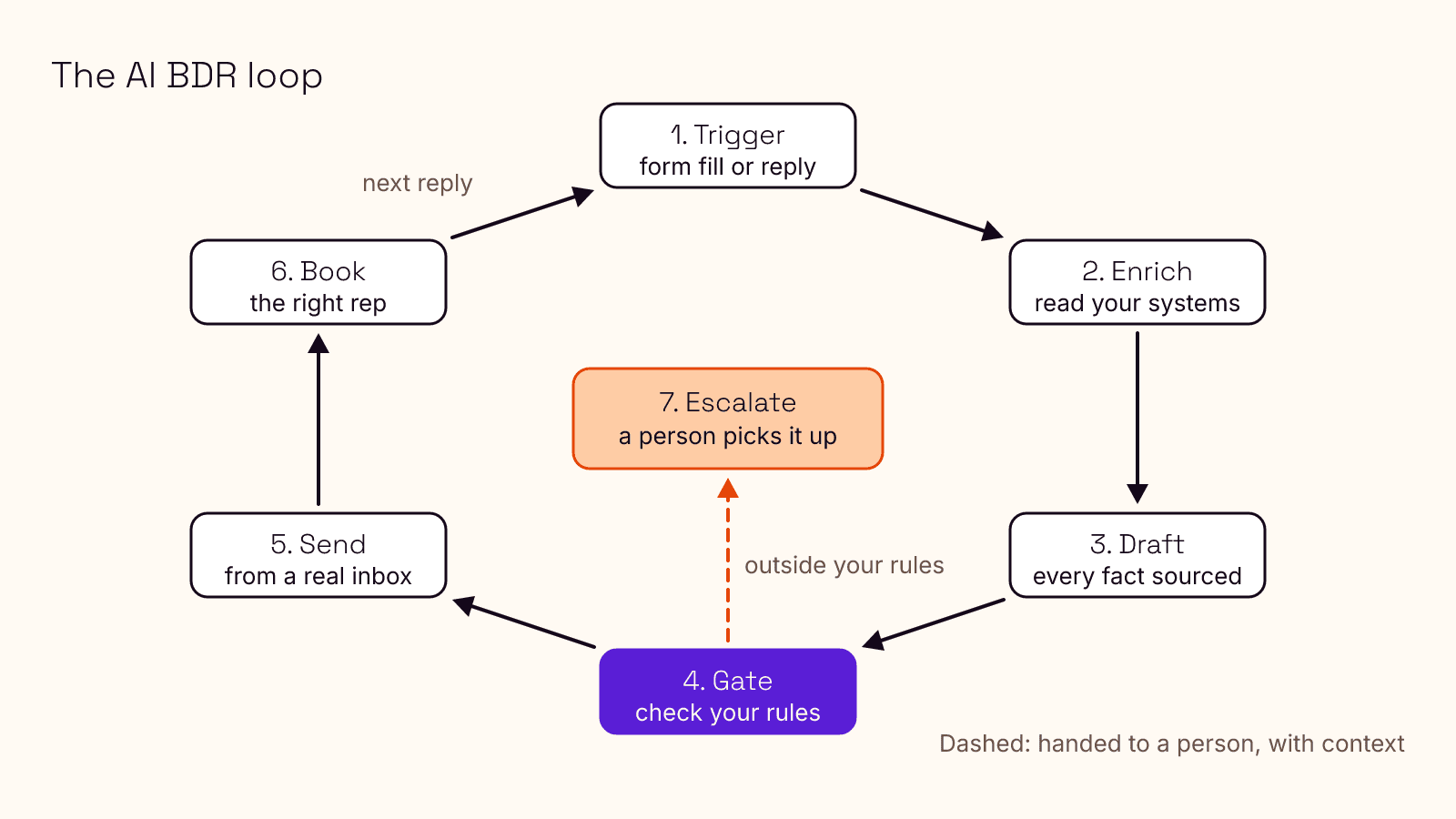
An AI BDR agent works one loop for every lead that reaches you, and that loop has seven steps. A vendor demo shows you the draft. The other six steps are where your pipeline leaks.
Vendors sell it as an AI SDR or an AI BDR; the two names describe the same job. This field note walks that job with nothing skipped. For each step you get what the agent does, who checks it, and where it breaks. Use it to judge a tool you are evaluating, or a build you are scoping.
What an AI SDR actually does all day
An AI SDR picks up a new lead or reply, writes a response it can source, and either sends it or hands the thread to a person. That is the whole job. Everything a vendor adds sits on one of seven steps.
Here is the loop, with the question each step has to answer.
| Step | What the agent does | The question it must answer |
|---|---|---|
| 1. Trigger | Notices a form fill, a reply, or a canceled call | Is this a thread I own? |
| 2. Enrich | Pulls the lead's record, company and history from your systems | Do I know enough to write something true? |
| 3. Draft | Writes the reply or the first message | Does every fact in this draft trace to a source? |
| 4. Gate | Checks the draft against your rules before it goes anywhere | Is this inside what I am allowed to send? |
| 5. Send | Sends from a real mailbox, on a schedule | Will this land in the inbox? |
| 6. Book | Offers times and puts the meeting on a calendar | Is this the right rep, at the right time? |
| 7. Escalate | Hands the thread to a person, with context | Can a human pick this up cold? |
The loop matters because the alternative is your reps doing it by hand. Salesforce, which sells sales software, surveyed 4,050 sales professionals in 22 countries for its 2026 State of Sales report. In Salesforce's report, reps said they spend 40% of their time selling. The full findings are in Salesforce's summary of the report.
Salesforce's report does not say where the other 60% goes. In an inbound loop, much of that time goes to steps 2 and 3. Enrichment is mostly copying, and drafting is mostly the same four paragraphs.
Three of the steps have their own field notes. Speed on step 1 is its own question: how fast an agent can answer an inbound lead. Step 3 at volume is personalization that survives volume. Step 4 is the rules that decide when a rep steps in.
One boundary first: choosing who to contact, and why they fit, happens upstream of this loop. That job is account research and client briefs. This loop starts once a name exists.
Can an AI agent book meetings from inbound leads?
Yes, an AI agent can book meetings from inbound leads, provided it can read your calendars and you have written down who takes which meeting. Booking is the easy part; the routing rule is the work.
Booking fails in predictable ways.
- Wrong rep. The agent books the next free slot, and your enterprise lead lands with the newest hire. Write ownership rules where the agent can read them.
- Wrong moment. A lead asked about pricing, and the agent sent a calendar link. Booking before answering reads as a dodge.
- Stale availability. Your rep blocked Friday in a personal calendar the agent cannot see; the meeting lands on a school pickup.
Fix those, and booking becomes the most measurable step in the loop. A meeting either appears on a calendar or it does not.
How an AI BDR handles a reply it cannot answer
A well-built AI BDR stops and hands the thread to a person when a reply falls outside its rules, instead of improvising an answer. Quality shows here more than anywhere else; a confident wrong answer to a buyer costs more than a slow right one.
Replies it cannot answer fall into a short list: custom pricing, contract terms, security questionnaires, a complaint about a past invoice. What they share is a commitment your company has not approved yet.
One ruling on a confident wrong answer is already on the record. In Moffatt v. Air Canada (2024), a British Columbia tribunal held the airline liable for what its website chatbot told a customer. The tribunal awarded C$650.88 in damages (C$812.02 with interest and fees), as law firm Dentons reported.
Small money, large principle: what your agent tells a prospect, your company told them.
So decide before launch which replies the agent hands off. Anthropic's engineering guidance names the pattern in one line: agents can pause for human feedback at checkpoints or when encountering blockers. In a sales loop, the checkpoint is a list.
| Reply type | What the agent does |
|---|---|
| Routine question with an answer in your materials | Answers it and logs the source |
| A request to schedule or reschedule | Handles it end to end |
| Pricing outside the published range | Hands off with the thread and a suggested reply |
| Legal, security or contract terms | Hands off; sends a holding line if you allow one |
| Anger, a complaint, anything personal | Hands off and sends nothing |
A good handoff reads like a colleague's note. It says who the lead is, what they asked, what the agent would have said, and why it stopped. Your rep should be able to reply in two minutes without opening another tab.
Write the handoff list before you write a single prompt. The tempting order is backwards: build the drafting first, demo it, then discover the exceptions in production, one apology at a time.
The list also sets which replies can go out unread. SideKind rolls a build out in three stages: shadow mode, then supervised, then autonomous. Before you start, name who on your team signs off on the end of each stage. Give them the handoff list, checked against real replies, as the evidence they read.
What an AI SDR costs per month
AiSDR, a vendor, publishes AI SDR plans from $250 to $2,500 a month, billed monthly. That list price is only one of five lines in what you pay. The plans scale by volume: $250 buys 200 researched contacts a month and $2,500 buys 2,500, according to AiSDR's pricing page.
Salesforge, another vendor, lists its agent, Agent Frank, at $499 a month billed annually, or $599 billed quarterly, on Salesforge's pricing page. Email sending infrastructure costs extra. We checked both prices in September 2026. Vendor prices change often, so confirm them before you budget.
A quote may show only the first line below. The other four decide whether the number you were quoted is the number you pay.
- The software or the build. A seat-priced tool, or a build fee plus a retainer.
- Model usage. Each enrichment and each draft is a model call; your volume sets this line.
- Sending infrastructure. Mailboxes and sending domains, warmed up before you use them at scale.
- Data. Enrichment credits from whichever provider fills in company and contact fields.
- Review time. The hours your reps spend reading drafts and picking up handoffs.
The fifth line is the easiest to miss. An agent that drafts well still needs a person for every thread it hands off, and a seat price never shows those hours.
Price every tool with your review hours included.
SideKind prices a build differently from a seat. The build is a fixed price at signed scope, and operating it is a monthly retainer. The range is confirmed on the diagnostic call, before you commit.
Where AI SDR tools break down
AI SDR tools break down at three points: the data they read, the volume they send, and the law in the recipient's inbox. Each is a structural limit, and better prompts remove none of them.
Stale or missing data
An agent writes from whatever your systems hold. If the CRM says a lead is a manager and they were promoted in the spring, the draft congratulates the wrong person on the wrong job. Your prospect notices within one line.
A vendor demo runs on clean data, so it rarely shows this step. Keeping records current is its own loop, covered in the CRM chores an agent should own.
Volume the inbox will not accept
Cheap drafting tempts teams into sending more, and mailbox providers publish exactly where that ends. Google asks every sender to keep the spam rate reported in its Postmaster Tools below 0.3%. Under the same guidelines, Google counts anyone sending more than 5,000 messages a day to Gmail accounts as a bulk sender, with stricter rules, including one-click unsubscribe. Both thresholds are in Google's sender guidelines.
That threshold does not care that an agent wrote the email. A burned domain costs you inbound deliverability too; your replies to real leads come from the same place.
The law in the recipient's inbox
Sending rules differ by where your prospect sits, and an agent knows only the ones you encode. Canada's law shows how specific they get. Under Canada's anti-spam law, an inquiry usually creates implied consent to message that person, but only for the six months after it. Canada's anti-spam law sets the maximum penalty for a violation at $10,000,000 for a company. Both rules are in the Act's own text.
So "follow up until they reply" is a legal question as well as a sales one. An agent chasing a seven-month-old inquiry is likely outside that window. Your rules have to say so, because the agent will not guess.
Common questions
Is AI replacing SDRs?
Not in the loop this field note describes: the agent takes the repetitive steps, and a person still owns the relationship. The agent answers routine replies and books the meeting; everything outside its rules goes to your rep. Your salesperson runs the call and owns the deal. What changes is where your rep's hours go: less time on routine replies, more on the calls the agent booked.
Are AI SDRs illegal?
Using an AI SDR is generally legal, but anti-spam rules treat every message it sends as your company's, whoever drafted it. Privacy law adds a layer: enrichment stores data a lead never gave you. California bars using an undisclosed bot online to mislead someone toward a sale or vote. Disclosure is a safe harbor under Business and Professions Code §§17940-17942. Have a lawyer check this; it is not legal advice.
What is an inbound SDR?
An inbound SDR is a sales development rep who works the leads that come to you, like form fills and demo requests. The job is to respond fast, qualify, and book a meeting for the rep who sells. Salesforce, which sells sales software, says AI SDRs are better suited today to inbound leads than to outbound. Before you hire for the seat, check which steps an agent could take.
Which AI SDR agent is the best?
No single AI SDR agent is best; the right one fits your loop. First ask whether your leads arrive inbound or go out cold. Inbound replies arrive with context the agent can check. Outbound starts cold, so each message needs more research and carries more deliverability risk. Test each candidate on the seven steps above with your own replies. Start with inbound, where a wrong message costs less.
What the diagnostic call is
The diagnostic call is a free, thirty-minute conversation about whether your inbound loop is ready for an agent. It ends with a yes, a no, or a not-yet. Its questions follow the five-question diagnostic. Kate, one of the demo agents on our site, walks a scripted inbound lead from first reply to booked meeting on her page. Book the call here. Bring your last twenty inbound replies to work through.